
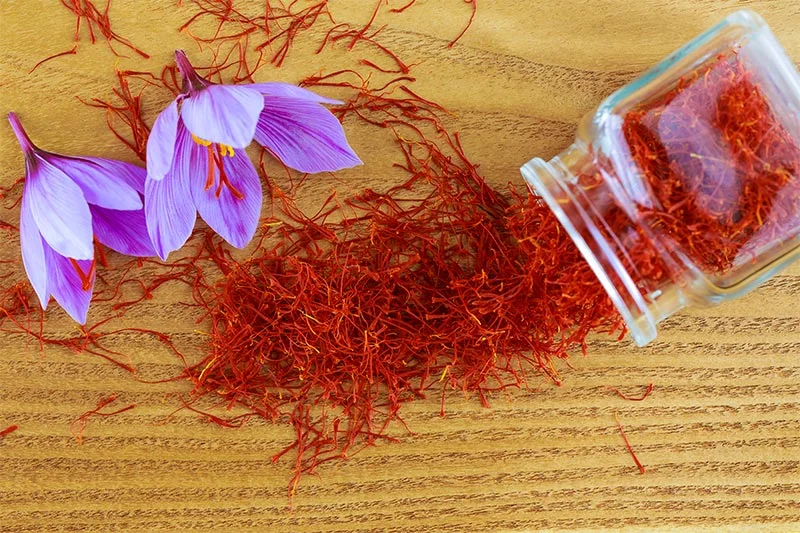
Saffron, indisputably the globe’s dearest flavoring for centuries, begins all its measurements in grams. Most recipes call for “a pinch,” about 20 dried stigmas from the center of Crocus sativus flowers, all of which stigmas were gathered, plucked and dried by hand only.
Each individual crocus sports a mere three stigmas (threads). Harvested in the late autumn — primarily from Iran, Afghanistan, India and Spain — roughly 250,000 of these stigmas make up around a pound. Saffron is rarely sold at retail in such a quantity. It’s sold at better grocery stores (or online) by the partial ounce or the gram at anywhere from $10 to $20 per gram, depending on quality and provenance.
The word comes by way of Arabic, “za’faran” (meaning “yellow”). Although the threads appear dark red, they yellow, never truly redden, the liquid in which they are always enlivened.
Accept no substitutes for saffron
Because it is so rare and costly, suppliers to kitchens worldwide have pushed substitutes, the most common over time being turmeric, which tastes or smells nothing like it, and merely resembles its coloring. Also, the flower of the safflower plant takes its name from saffron because it, likewise, stepped forward as a worthy interloper. It isn’t.
Long ago, Nuremberg, Germany, was a main trading place for it and, in the late Middle Ages, held a saffron fair where saffron was a financing security (or payment, or bribe). The Nuremberg police frowned on substitutes, of course, and threatened those who might commit such fraud with “death by burning or being buried alive.” Oh my.
Why saffron has been prized for centuries
In Greek mythology, Zeus slept on a bed of saffron and crocus flowers. (Among its several medicinal attributes, saffron is considered an aphrodisiac. Zeus always thought ahead.) Ancient Greek legend has it that Hermes, the messenger, accidentally struck the head of his close friend, Crocos, with his sword. Where drops of blood fell from the head of Crocos, wee bluish flowers sprung with, of course, blood-red saffron stigmas at their centers.
Cooking with — certainly eating — saffron was a sign of wealth and power since well before the Roman Empire. (Sugar played the same role after sugarcane was introduced to Europe after Columbus.) This was so not only because of saffron’s scarcity and expense, but also precisely because of its coloring effect. It “gilded” food and, thereby, the eater of it.
After the death of the Buddha in the fifth century B.C.E., his priests began to dye their robes using saffron, in homage to him and as a sign of renunciation, because yellow and yellow-orange signify such in Hinduism. (Buddhist monks now use commercial dyes or turmeric.)
Saffron shines in sweet and savory dishes around the globe
In many foods of the Mediterranean, Middle East and Far East, saffron is indispensable, almost all times appearing in wet or steamed preparations: bouillabaisse, paella, risotto Milanese, Persian tahdig, bourride (a fish stew), b’stilla (the pigeon pie of Morocco) — the list goes on and on.
It is common, nearly ubiquitous, in the many rice dishes of Spain, Cuba, India, and Iran. Because of how its native bitterness plays off honey or sugar — not to mention its haunting aroma, spicy flavor, and tenacious color — it often appears in desserts, as in the recipe here.
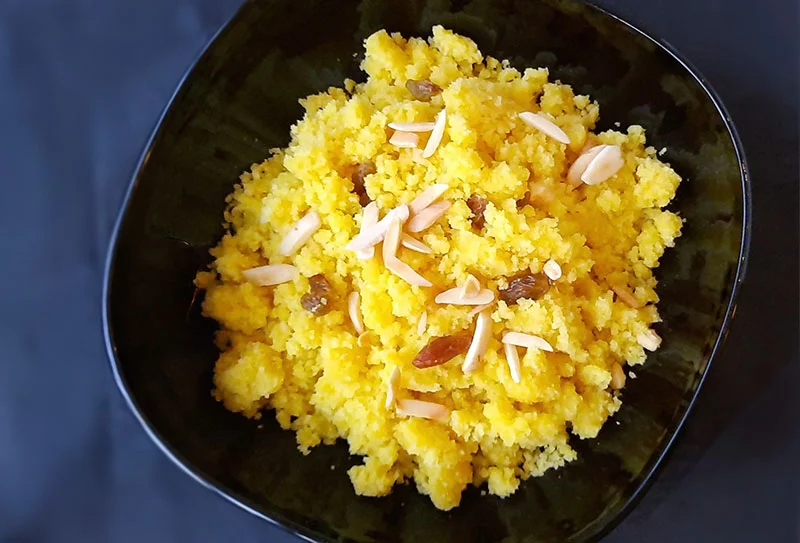
Halwa (sometimes spelled Halwah or Halva) is a Persian semi-sweet dessert based in semolina flour and flavored with saffron. It is typically called a “pudding,” but it is more like a moist pilaf. Leftover Halwa may be re-warmed and served with a topping of melted ghee or butter, or with warm cream.
If you rewarm it with a substantial amount of milk or cream, you will not be able to go back again to a breakfast of plain Cream of Wheat.
You will have been gilded.
Halwa recipe
Adapted from sbs.com.au/food and Romy Gill at saveur.com. Serves 6-8.
Ingredients
- 2/3 cup sugar
- 1 cup whole milk
- 1 3/4 cups water
- Seeds from 4 crushed green cardamom pods (about 1/4 teaspoon)
- 1/2 teaspoon saffron threads or 1 tablespoon saffron water (see recipe)
- 2 tablespoons coarsely chopped raw cashews
- 3 tablespoons golden or green raisins
- 1/4 cup plus 2 tablespoons ghee or unsalted butter
- 1 1/2 cups semolina (durum wheat) flour (see note)
- 1 rounded tablespoon slivered almonds, lightly toasted
Directions
- Remove the seeds from the cardamom pods by smashing each pod with the bottom of a heavy glass and separating the small blackish seeds from the “shells.” If using saffron threads, pulverize them using a mortar and pestle.
- To a medium pot set over medium heat, add the sugar, milk, water, cardamom seeds, and saffron. Bring to a slow boil and cook, stirring occasionally, until the sugar dissolves and the liquid has reduced to a light syrup, about 10 minutes. Toss in the raisins and cashews, stir the mix, and set aside.
- To another medium pot set over medium-low heat, add the ghee or butter and melt it. Add the semolina and cook, stirring frequently, until toasted and slightly browned, about 8 minutes.
- Cautiously stir in the reserved syrup mix (the semolina in the pot will bubble up at first) and continue cooking, stirring frequently, until the halwa obtains a crumbly consistency, 2-3 minutes.
- Transfer portions to warmed bowls, sprinkle with the almonds and serve.
Cook’s notes: You may use coarse or fine semolina. The brand Bob’s Red Mill packages semolina and is in fairly wide distribution. You may substitute coarse whole wheat flour.
Saffron Water recipe
Makes about 1/2 cup.
Ingredients
- 1/2 teaspoon saffron threads
- 1/8 teaspoon salt or sugar
- 1/2 cup hot water
Directions
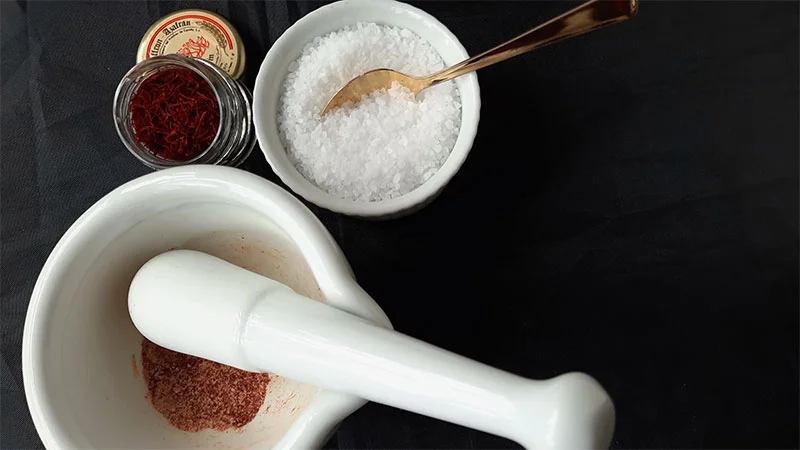
- Using a mortar and pestle or molcajete, grind down the saffron threads with the salt or sugar until pulverized (see photo). In a small cup or jar, add the powder and hot water and stir or occasionally shake until the saffron dissolves, upwards of an hour.
- Store the saffron water in the refrigerator for up to 2 weeks or divvy up the water into 1-tablespoon portions in an ice cube tray and freeze until solid. Pack the cubes for later use.
For recipes that call for a “healthy pinch” of saffron, use 1 tablespoon saffron water.