
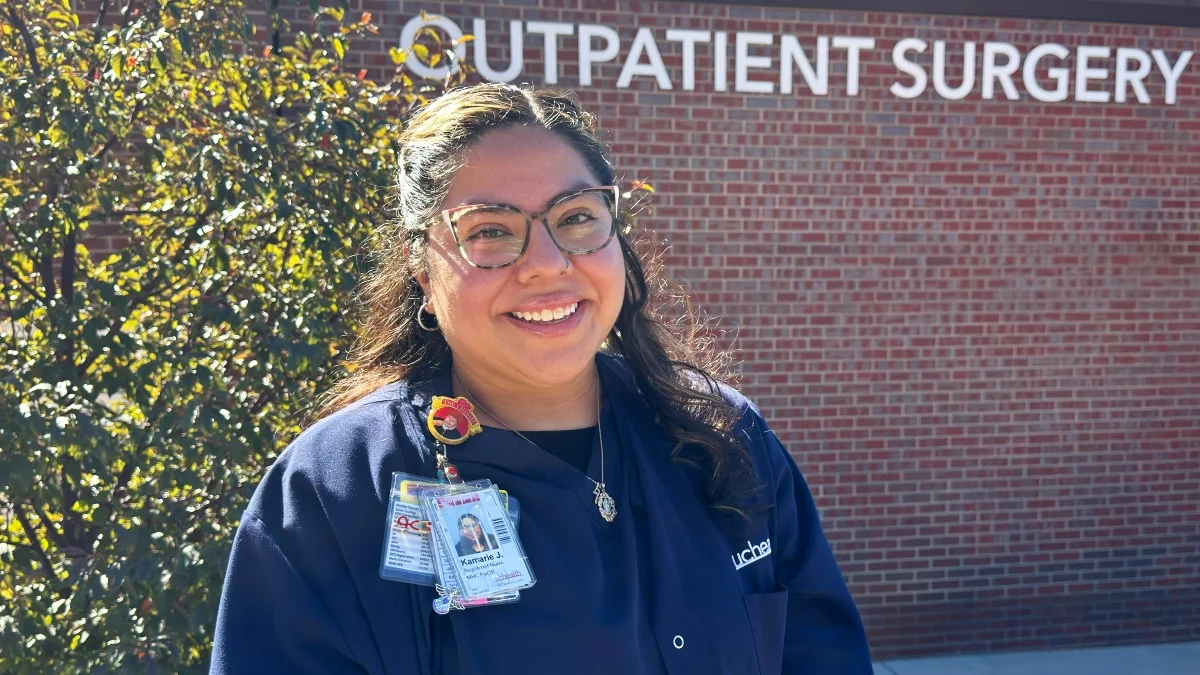
Honoring service and improving care
Before undergoing a procedure at UCHealth Memorial Hospital Central, a patient hesitated when asked about their military status and history with post-traumatic stress disorder (PTSD).
Kamarie Johnson, a charge nurse in outpatient surgery, explained that having this information could help the care team make waking from anesthesia safer and more comfortable. The patient shared more about their military service and noted that loud environments could be difficult. The patient’s care team ensured the recovery area remained quiet, and the patient told Johnson that their wake-up experience went well.
“Talking to somebody and knowing they care about what you’re saying is important,” Johnson said. “Sometimes, it’s just taking those extra couple of minutes to check in.”
The interaction was exactly what Johnson hoped to achieve through her UEXCEL project focused on military patients.
When her leaders sought ways to better support military patients experiencing anxiety or other challenges after anesthesia, Johnson stepped in. Her project established a workflow that helps preoperative teams more accurately identify military-affiliated patients, document their status in electronic health records, and, when appropriate, ask about PTSD and prior anesthesia reactions. Her goal is to help staff build trust, giving patients the opportunity to share concerns and what could make recovery more comfortable.
“It’s a population that’s always been close to my heart,” Johnson said.
Johnson grew up in Colorado Springs in an Army family and later became a military spouse. She is also pursuing a Master of Science in Veteran and Military Healthcare.
Throughout her project, she discovered that an American flag icon used to identify military patients in electronic health records wasn’t visible to outpatient teams and that imprecise charting language could prevent veterans from being properly identified.
The health record chart asked whether a patient was “currently serving,” with response options including yes, no and veteran. Johnson worked with registration, information technology and other UCHealth teams to change the prompt to “military status,” making it clearer that it includes veterans as well as active-duty and reserve service members. Military-affiliated patients can then be asked follow-up questions about their service branch and PTSD.
What began as a professional development project soon expanded beyond Johnson’s unit. The changes she implemented are now live across UCHealth. Johnson also developed staff education resources to reinforce the workflow.
“This population needs to be identified across the board,” Johnson said.
Her project led to a significant improvement in PTSD identification among military-affiliated patients. Before the changes, only 6.5% of the military-affiliated patients Johnson reviewed were identified as having PTSD. After implementation, that figure rose to 19%, helping connect more patients with the resources and support they may need.
For Johnson, the impact goes beyond documentation.
“Regardless of how long they served, the military is a big part of anyone’s life,” Johnson said. “This project helps recognize them and make them feel seen.”